One of the most common questions we hear from marketing teams is:
“Are we performing where we should be?”
Whether you’re evaluating lifecycle conversion rates, email engagement, or pipeline velocity, it can be difficult to know what’s healthy without a benchmark for comparison.
The challenge is that most benchmark reports focus on conversion rates while overlooking something equally important: time.
How long should it take a lead to become an MQL? How quickly should MQLs turn into pipeline? How long should opportunities remain open before becoming customers?
To help answer those questions, our research intern, Casey Logan, analyzed hundreds of thousands of marketing and sales data points to identify benchmark conversion timelines and email performance metrics. While every business is different, the data provides valuable context for understanding how your own funnel compares.
Want to dig into the data yourself?
Download the full 2026 Benchmark Analysis Report to explore the complete methodology, distributions, confidence intervals, and benchmark metrics across lifecycle conversion stages and email performance.
[Download the Full Benchmark Report]
The Average Lead Takes Nearly 10 Months to Become an MQL
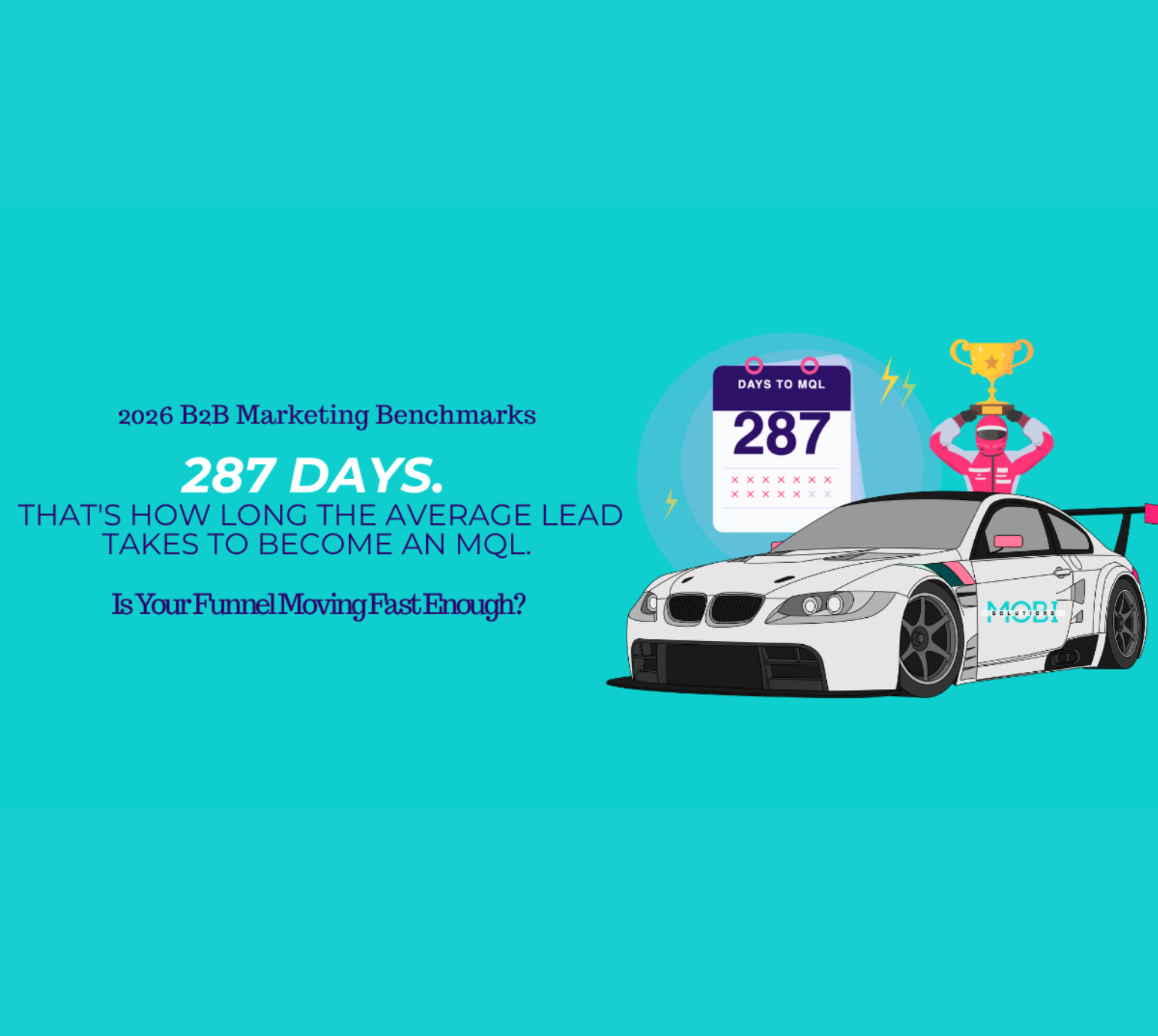
The benchmark analysis found that the average time from becoming a known lead to reaching MQL status was 287 days (!!!)
For organizations focused on quarterly targets, that number may feel surprisingly high.
It’s easy to assume that successful campaigns generate immediate results. In reality, many prospects spend months consuming content, attending events, researching solutions, and evaluating options before demonstrating enough intent to qualify as an MQL.
This finding serves as a reminder that marketing impact often unfolds over much longer periods than reporting cycles suggest.
MQLs Don’t Immediately Become Pipeline
The average time from MQL to Pipeline was 135 days.
While organizations often focus on generating more MQLs, this benchmark highlights another important consideration: how efficiently those MQLs move through the funnel.
If your timeline is significantly longer than this benchmark, it may be worth investigating whether qualification criteria, sales follow-up processes, or nurture strategies are slowing progression.
If you’re moving faster than average, understanding why can be just as valuable.
Pipeline to Revenue Is the Longest Stage of the Journey
The benchmark analysis showed an average of 486 days from Pipeline to Closed Won.
This reinforces an important reality for marketing and revenue teams: revenue outcomes often lag far behind the activities that influence them.
When organizations evaluate performance exclusively through a short-term lens, they risk underestimating the impact of programs that contribute to pipeline and revenue over longer periods of time.
The Most Surprising Finding: Not All Leads Follow the Same Path
One of the most interesting discoveries emerged when looking at the Known-to-MQL timeline.
Rather than forming a single distribution, the data appeared to split into two distinct groups.
The first group reached MQL status relatively quickly, averaging 86 days.
The second group averaged 1,314 days before becoming an MQL.
That’s not a small difference. It’s the difference between a prospect converting within a quarter and a prospect converting years later. This finding reinforces something many marketing teams experience firsthand: not every buyer enters the market at the same stage of readiness. Some are actively searching for solutions today. Others may not be ready to engage until months or years later.
The organizations that consistently generate pipeline are often the ones that successfully engage both groups.
Email Performance Benchmarks
The analysis also examined email engagement metrics.*
Average open rate: 24.8%
Average click-to-open rate: 14%
*These benchmarks can provide useful context when evaluating campaign performance, but they should never be viewed as universal targets. Industry, audience, buying cycle, email type, and data quality all influence engagement. A company selling enterprise software to a small group of decision makers should expect different performance than an organization communicating with a broad audience.
What This Means for Your Team
The most important takeaway from this analysis isn’t whether your numbers match the benchmark.
It’s understanding how your funnel behaves relative to the broader market.
The data suggests:
- Buyers often move more slowly than organizations expect.
- Funnel velocity deserves just as much attention as conversion rates.
- Long-term nurture strategies play a critical role in future pipeline creation.
- Averages tell part of the story, but distributions reveal the real opportunity.
Benchmarking can help identify areas worth investigating. But the most valuable insights will always come from understanding your own data and the unique behavior of your buyers.
The goal isn’t to beat a benchmark.
The goal is to understand what’s normal, identify where you’re different, and determine whether those differences represent a problem—or a competitive advantage.
Curious how your results compare?
Download the full benchmark report and compare your own lifecycle conversion timelines and email engagement metrics against the research.
[Download the Full Benchmark Report]
Note: These benchmarks are intended to provide context, not prescribe targets. Industry, deal size, sales cycle, and go-to-market strategy can all influence performance.